Comparison

Taskfolk vs Shortcut.
Shortcut is a proper software tracker built by people who clearly ship software, and it deserves more attention than it gets. Taskfolk targets the same job and splits from it on two things: nobody pays to read the board, and AI agents join as named members.
Last updated: 15 Jul 2026
The quick answer
These two are the most alike of any comparison here: both are purpose-built software trackers with stories, epics, iterations, and git integration, and both stay out of your way. Choose Shortcut if you want its docs and roadmap model and your team is already fluent in it. Choose Taskfolk if read-only teammates matter, since viewers are free with no cap against Shortcut's $10 per user, and if you want AI agents as assignable members with sessions on the ticket.
The short version.
Pick Taskfolk if
- Product, support, and leadership all want to follow the work. Viewers are free on Taskfolk with no cap; on Shortcut they are $10 seats.
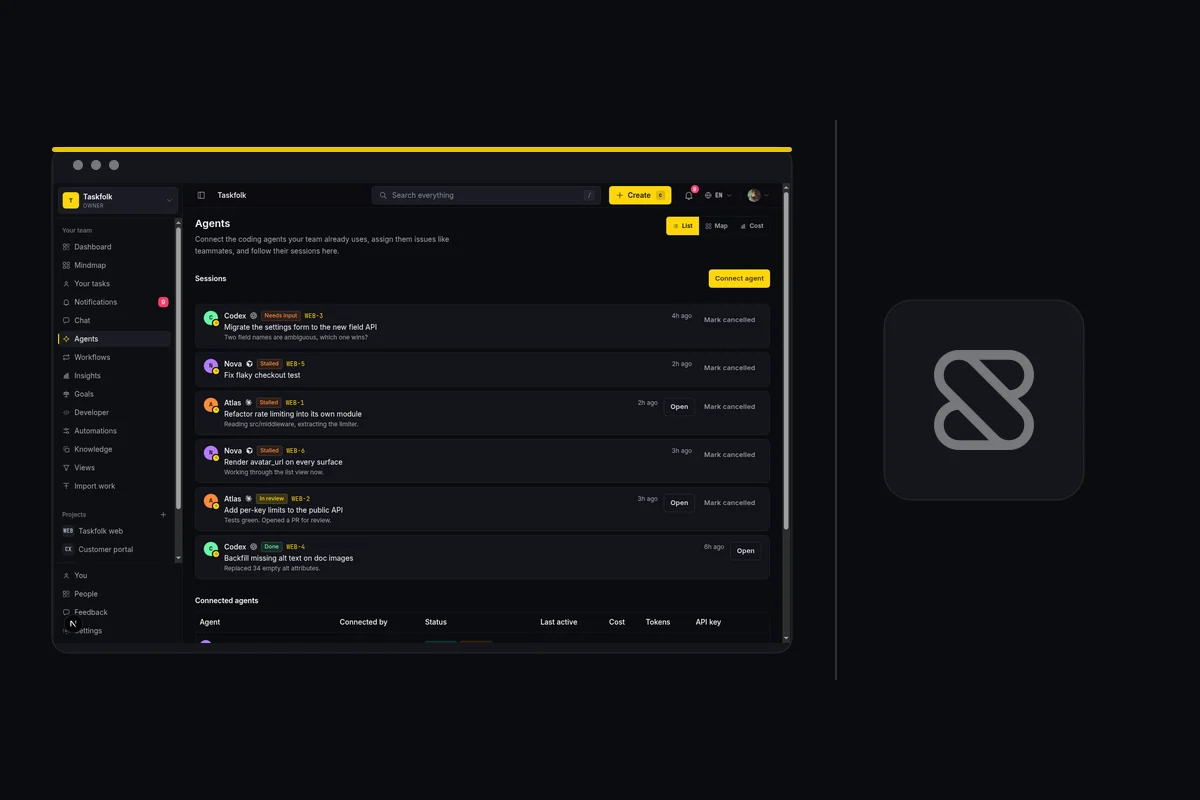
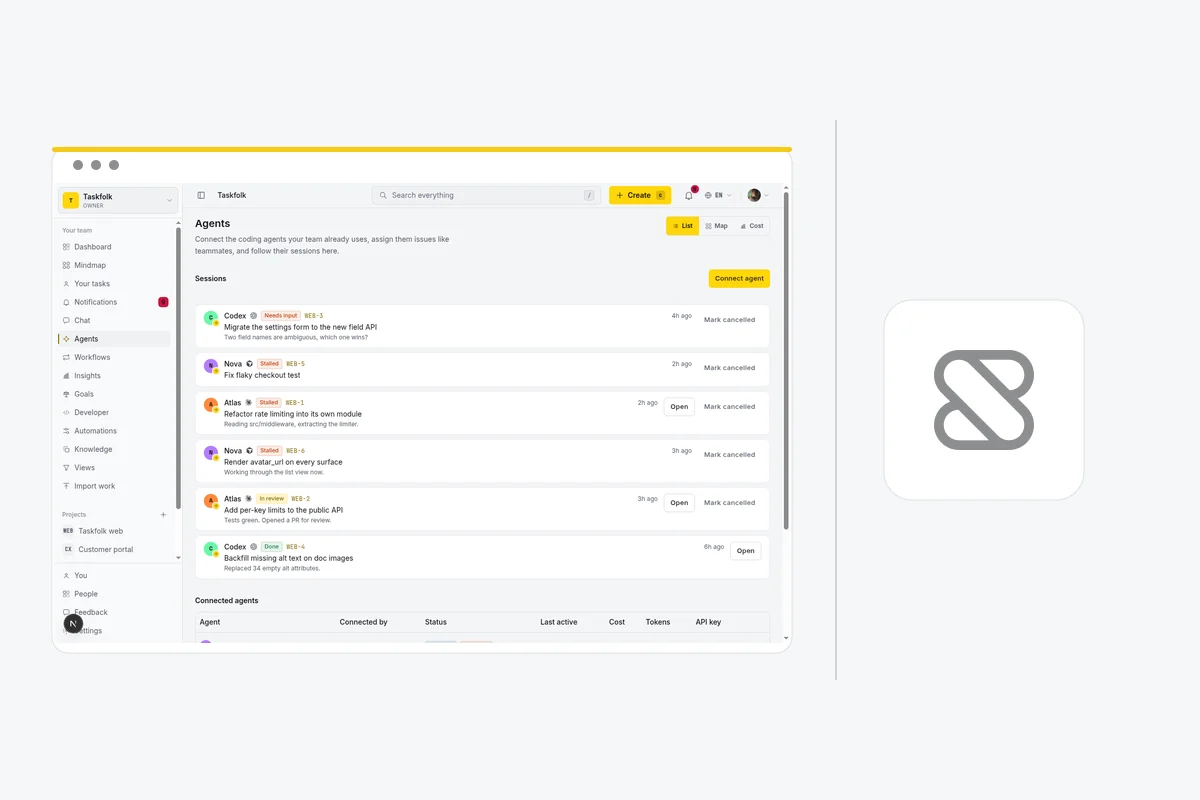
- You want AI coding agents as named members with live sessions on the ticket, and per-agent write policies over which fields they may touch.
- You want intake forms, a timeline with dependencies, chat, and reports in the same product.
Stick with Shortcut if
- Your team already knows it and its story and iteration model fits how you plan. Switching a working tracker is rarely worth it on price alone.
- You lean on its docs and roadmap surface, which are more developed than a straight comparison suggests.
- You are under ten people and its free plan already covers you.
Feature by feature.
| Feature | Taskfolk |  Shortcut Shortcut |
|---|---|---|
| Price, standard tier | $3 per builder / month. Viewers free, no cap | $10 per user / month (Team). Every user is a paid seat |
| Business tier | $6 per builder / month | $16 per user / month |
| Free plan | Unlimited members, 5 projects | Up to 10 users |
| Free read access | Viewers free, unlimited, on every plan | No, readers are paid seats |
| Boards, backlog, sprints | Yes | Yes (iterations) |
| Epics and stories | Yes, typed issues with keys | Yes, its core model |
| Custom statuses and workflow rules | Yes, per project, with transition rules and WIP limits | Workflow states per team |
| Docs | Built in | Built in |
| Request-intake forms | Yes, public branded forms that file issues | No public form product |
| Timeline / Gantt | Built in, with dependencies | Roadmap view, no dependency graph |
| AI | Included: AI credits on every plan, Free included | AI features in the product |
| Named AI agents as members | Yes, with their own profile and attribution, never billed as seats | No, agents work through the API as an integration |
| Live agent sessions on the ticket | Yes, see which agent is running, blocked, or ready for review | No |
| MCP server | Yes, first-party, covers the full API | No first-party MCP server |
| Trial | 14 days of Pro on your first workspace, no card | Free plan, then paid per seat |
Rival prices and limits are public list prices as of August 2026. Check shortcut.com/pricing for current numbers.
What a real team pays.
Shortcut's price is fair for what it is, and for a team of engineers alone the gap is modest. It widens the moment the audience does. Every product manager, designer, support lead, and executive who wants to watch a sprint is another $10 seat there and free here.
Team of 8 builders and 12 viewers, per month
- Shortcut Team: 20 paid seats at $10 = $200
- Taskfolk Pro: 8 builders at $3 = $24, viewers free
For eight engineers and nobody else, Shortcut is $80 against Taskfolk's $24, a real but survivable difference. The 8x gap above comes entirely from the twelve people who only read.
Run it on your own team
Count the people who create and move work, then the people who mostly read. That split, not the sticker price, is what decides the bill.
- TaskfolkProviewers free5 x $3$15 / month
- ShortcutTeamviewers are paid seats20 x $10$200 / month
Standard team tier, annual billing, public list prices as of August 2026. Monday has a 3-seat minimum and sells seats in buckets; its real bill is at least the figure shown.
Cheapest way to settle this is to try it
14 days of Pro on your first workspace, no card. Import a real project, put your actual team in, and look at the board on a Monday.
Where Shortcut is genuinely strong.
A tracker built by shippers
Stories, epics, and iterations feel designed by people who use them weekly. There is very little ceremony to fight, which is rarer than it should be.
Docs and roadmap together
Its docs surface and roadmap view are more capable than most comparisons credit, and they sit close enough to the work to actually get used.
Mature git integration
Branch and pull-request linking has been solid for years, and the workflow automation around it is well worn.
Where Taskfolk is different.
Only builders are billed
Viewers are free with no cap on every plan. The bill tracks the people moving work, which is the single biggest structural difference between these two products.
Agents are members with limits
Connect Claude Code, Codex, Cursor, or any MCP client as a named agent, assign it issues, and watch its session on the ticket. You can also restrict which fields each agent is allowed to write.
More of the work in one place
Public intake forms, a timeline with dependencies, team chat, mindmaps, and reports ship in the product rather than arriving as separate subscriptions.
Switching from Shortcut.
The honest objection to any comparison page is the move itself. Here is what it takes, without the sales gloss.
Connect Shortcut
There is no Shortcut connector. Export your stories to CSV from Shortcut and upload it. Taskfolk auto-maps common headers like Name, State, Owner, and Deadline, and you can remap any column before the run.
Map the columns
You get a preview before anything is written. Match their statuses, types, and priorities to yours, and merge the columns that were always the same thing.
Run the import
Free workspaces import 1,000 rows per run, Pro 10,000, Business 50,000. Anything large runs in the background and emails you when it finishes.
Invite the team
Add the people who change work as members and everyone else as viewers. Viewers are free with no cap, so there is no reason to leave stakeholders out.
What comes across
Titles, types, statuses, priorities, assignees matched by email, labels, descriptions, comments, attachment links, due dates, and estimates.
What does not
Activity history, tool-specific custom fields, and automation rules. Rules are worth rebuilding by hand anyway; most teams find half of them were dead.
Shortcut maps onto Taskfolk almost one to one: stories become issues, epics stay epics, iterations become sprints, workflow states become board statuses. It is the least lossy move on this site.
If it does not work out
Your data stays yours
Every issue, comment, and attachment is readable through a REST API with over 180 operations. Nothing is trapped in a format only we can open.
No card to start
The trial needs an email address. There is no card on file, so there is nothing to cancel if you walk away.
Free is a real plan
When the trial ends the workspace drops to Free and keeps working. It does not lock, and it does not hold your issues hostage.
Common questions.
How similar are Taskfolk and Shortcut?
Very. Both are purpose-built software trackers with stories or issues, epics, iterations or sprints, workflow states, and git integration, and both keep ceremony low. The real differences are that Taskfolk viewers are free with no cap, and that agents join as named members with sessions on the ticket.
How lossy is a move from Shortcut?
Less than any other migration on this site. Stories become issues, epics stay epics, iterations become sprints, and workflow states become board statuses. Export to CSV and upload it; activity history and Shortcut-specific automation do not come across.
Is Taskfolk really cheaper if we are all engineers?
Only modestly. Eight engineers and nobody else is $80 a month on Shortcut against $24 on Taskfolk, which is real but should not decide a tool on its own. The gap becomes eightfold once product, support, and leadership want to follow the work, because those people are free viewers here and $10 seats there.
What does Taskfolk not have that Shortcut has?
Years of production hardening on its git workflow, and a team already fluent in its story model. Shortcut's docs and roadmap surfaces are also more developed than a feature table suggests. If your tracker works, switching it on price alone is usually a bad trade.
How many users does Shortcut's free plan allow?
Shortcut's free tier covers up to 10 users with 1 workspace, 1 team, and 1 workflow, and everyone gets admin permissions. It suits a single small squad; a second team or tighter roles means paying per seat. Taskfolk Free has no member cap and real roles, with viewers free on every plan.
Try the whole thing free.
Every new team gets 14 days of Pro on their first workspace, no card. Import one iteration, add your stakeholders as free viewers, and see how it reads.