Comparison

Taskfolk vs Asana.
Asana is polished work management that scales across departments, and it is priced like it. Taskfolk covers the tracker core at a fraction of the seat price, includes docs and AI in the plan, and lets AI agents work as named teammates.
Last updated: 15 Jul 2026
The quick answer
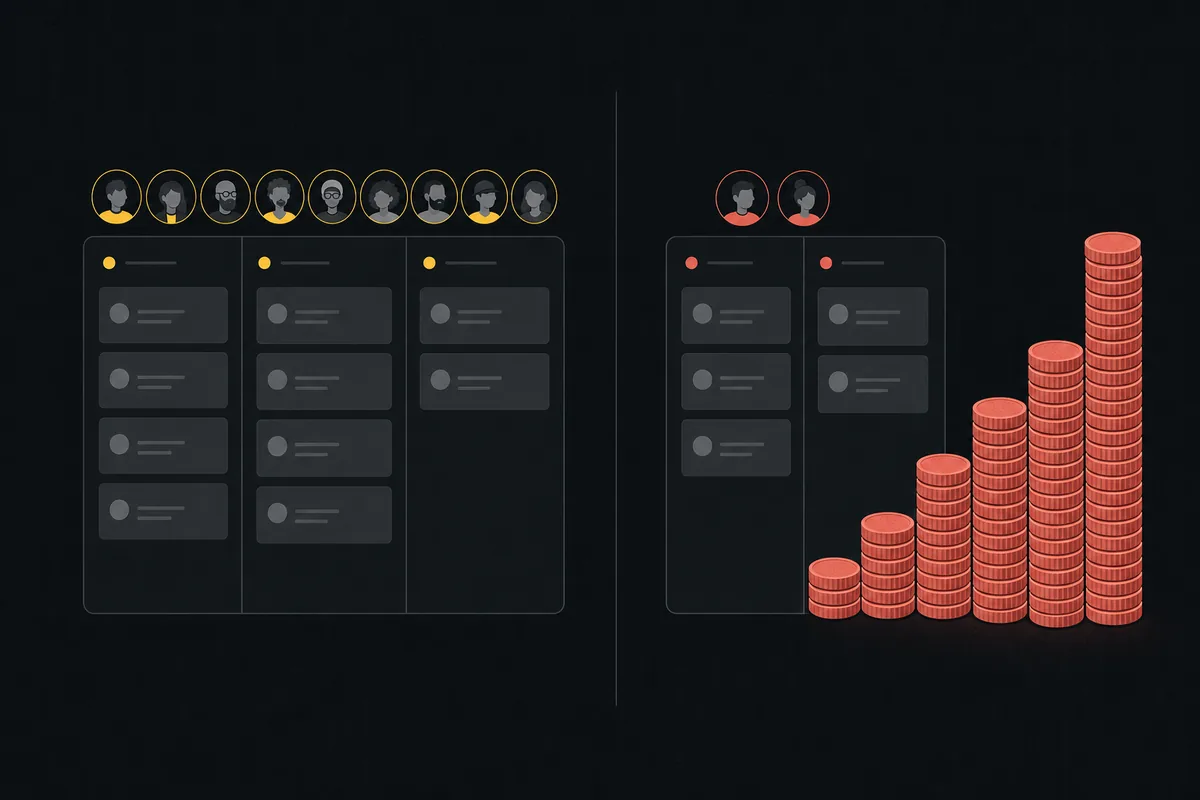
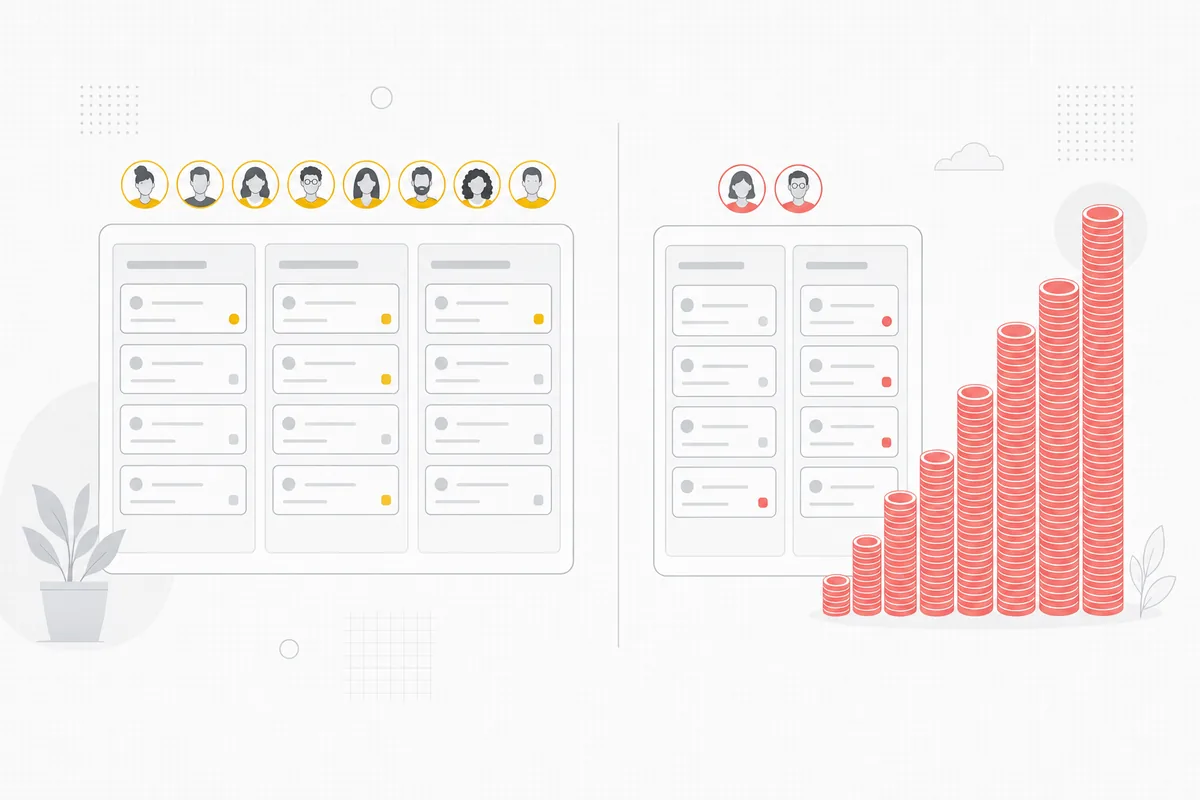
Stay on Asana if you run org-wide goals, portfolios, and workload planning across departments, which is the layer Taskfolk does not attempt. Move to Taskfolk if the bill is the problem: Asana starts at $10.99 per user and puts time tracking and portfolios on the $24.99 Advanced tier, while Taskfolk is $3 per builder with free unlimited viewers and every feature on every plan. A team of 5 builders and 20 internal viewers is about $275 a month on Asana Starter and $15 on Taskfolk Pro.
The short version.
Pick Taskfolk if
- The bill matters: Asana starts at $10.99 per user and the features teams actually want, time tracking, goals, portfolios, live on the $24.99 Advanced tier.
- You want a free plan a whole team can use. Asana's free plan is capped at 2 users for new accounts; Taskfolk's is unlimited members with 5 projects.
- You want issues with multiple assignees, built-in docs, and AI coding agents as named members with live sessions.
Stick with Asana if
- You run org-wide goals, portfolios, and workload planning across many departments; that layer is Asana's home turf.
- Your marketing and ops teams already live in it and like it; Asana's polish for non-technical work is real.
- You rely on Asana-specific integrations or its enterprise admin surface.
Feature by feature.
| Feature | Taskfolk |  Asana Asana |
|---|---|---|
| Price, standard tier | $3 per builder / month. Viewers free, no cap | $10.99 per user / month (Starter) |
| Upper tier | $6 per builder / month (Business) | $24.99 per user / month (Advanced) |
| Free plan | Unlimited members, 5 projects | 2 users for accounts created after Nov 2025 |
| Free read access | Viewers free, unlimited, on every plan | Unlimited free guests on paid plans (external collaborators) |
| Multiple assignees per task | Yes | No, one assignee per task |
| Docs and wiki | Built in | No standalone docs product |
| Time tracking | Built in, every plan | Advanced tier ($24.99) and up |
| AI | Included: AI credits on every plan, Free included | AI Studio credits on paid plans |
| Named AI agents as members | Yes, with their own profile and attribution, never billed as seats | AI teammates for enterprise customers |
| Live agent sessions on the ticket | Yes, see which agent is running, blocked, or ready for review | No |
| MCP server | Yes, first-party, covers the full API | Yes, first-party, a smaller tool set (~17 tools) |
| Trial | 14 days of Pro on your first workspace, no card | 30 days on paid tiers |
Rival prices and limits are public list prices as of August 2026. Check asana.com/pricing for current numbers.
What a real team pays.
Asana's guests are genuinely free, but guests are external collaborators. Your own teammates, the manager who reads the board, the support person checking a ticket, are full seats at $10.99, or $24.99 once you need time tracking and portfolios. On Taskfolk, internal viewers are free and every feature ships on every plan.
Team of 5 builders and 20 internal viewers, per month
- Asana Starter: 25 seats x $10.99 = about $275
- Taskfolk Pro: 5 builders x $3 = $15, viewers free
On Asana's Advanced tier the same team is about $625 a month. To be fair the other way: Asana's 30-day trial is longer than Taskfolk's 14 days, and its free guest policy is generous for agencies working with external clients.
Run it on your own team
Count the people who create and move work, then the people who mostly read. That split, not the sticker price, is what decides the bill.
- TaskfolkProviewers free5 x $3$15 / month
- AsanaStarterviewers are paid seats20 x $10.99$220 / month
Standard team tier, annual billing, public list prices as of August 2026. Monday has a 3-seat minimum and sells seats in buckets; its real bill is at least the figure shown.
Cheapest way to settle this is to try it
14 days of Pro on your first workspace, no card. Import a real project, put your actual team in, and look at the board on a Monday.
Where Asana is genuinely strong.
The goals and portfolio layer
Org-wide goals, portfolios, and workload views that leadership actually uses. If you manage many teams' work as one system, this layer is the product, and Taskfolk does not attempt it.
Polish at scale
Asana draws the fewest performance complaints of the big work-management suites, and the mobile app is reliably good. Large non-technical orgs feel that quality daily.
Marketing and operations fit
Intake forms, approvals, and campaign-shaped templates make it a natural home for marketing and ops teams, not just product.
Where Taskfolk is different.
No price cliff
Asana more than doubles per seat when you need time tracking or portfolios. Taskfolk has two paid tiers, $3 and $6, and the tracker feature set ships on all of them, Free included.
Agents are teammates, not scripts
Connect Claude Code, Codex, Cursor, or any MCP client as a named agent. Assign it issues, watch its session run on the ticket, and see every change attributed in the activity log. Agent members are never billed.
Docs live with the work
Specs and notes are a first-class part of the workspace, linked from issues and searchable by your agents, not a separate product you still have to buy.
Switching from Asana.
The honest objection to any comparison page is the move itself. Here is what it takes, without the sales gloss.
Connect Asana
Paste an Asana personal access token and pick the project. Tasks, assignees, due dates, descriptions, and comments come across.
Map the columns
You get a preview before anything is written. Match their statuses, types, and priorities to yours, and merge the columns that were always the same thing.
Run the import
Free workspaces import 1,000 rows per run, Pro 10,000, Business 50,000. Anything large runs in the background and emails you when it finishes.
Invite the team
Add the people who change work as members and everyone else as viewers. Viewers are free with no cap, so there is no reason to leave stakeholders out.
What comes across
Titles, types, statuses, priorities, assignees matched by email, labels, descriptions, comments, attachment links, due dates, and estimates.
What does not
Activity history, tool-specific custom fields, and automation rules. Rules are worth rebuilding by hand anyway; most teams find half of them were dead.
Asana allows one assignee per task, so nothing is lost on the way in. Multi-assignee issues are something you gain afterwards, not a mapping problem.
If it does not work out
Your data stays yours
Every issue, comment, and attachment is readable through a REST API with over 180 operations. Nothing is trapped in a format only we can open.
No card to start
The trial needs an email address. There is no card on file, so there is nothing to cancel if you walk away.
Free is a real plan
When the trial ends the workspace drops to Free and keeps working. It does not lock, and it does not hold your issues hostage.
Common questions.
Can I import from Asana?
Yes. Taskfolk's importer brings tasks, statuses, assignees, and comments across from Asana, along with Jira, Trello, ClickUp, Linear, and CSV. Free workspaces import up to 1,000 rows per run, Pro 10,000, Business 50,000.
Are Asana's free guests the same as Taskfolk's free viewers?
Not quite. Asana's unlimited free guests are external collaborators, people outside your email domain. Your own teammates are paid seats regardless of how little they edit. Taskfolk's viewers are free for anyone, internal or external, on every plan.
We only have two people. Isn't Asana's free plan enough?
For two people it is a fine free plan. The cap is the issue: the third person you invite turns the whole team into paid seats. Taskfolk's free plan has no member cap, so a growing team is not forced into a pricing decision by headcount alone.
Does Taskfolk have goals and portfolios?
Yes. Taskfolk has portfolios that roll several projects into one health view, and goals with weighted key results (set manually or auto-updated from real work), alignment, and cycle status. These shipped in mid-2026, so an older writeup calling Taskfolk tracker-only is out of date. Asana still goes deeper on org-wide goal cascades, but the gap is much narrower than it was.
What about AI on both sides?
Asana's AI Studio is credit-based on paid plans, and its AI teammates are an enterprise feature. Taskfolk includes AI credits on every plan and lets any MCP client, Claude Code, Codex, Cursor, join as a named agent with full API access and per-issue session visibility.
Did Asana reduce its free plan to 2 users?
Yes. Asana's free Personal plan now covers up to 2 users for accounts created after November 12, 2025; older accounts keep a legacy 10-seat version. A small team on a new account outgrows the free tier the moment a third person joins, and Starter is priced per seat. Taskfolk's Free plan keeps unlimited members and unlimited issues regardless of when you signed up.
Try the whole thing free.
Every new team gets 14 days of Pro on their first workspace, no card. Bring your Asana projects over and run the seat math on your own team.