Comparison

Taskfolk vs Height.
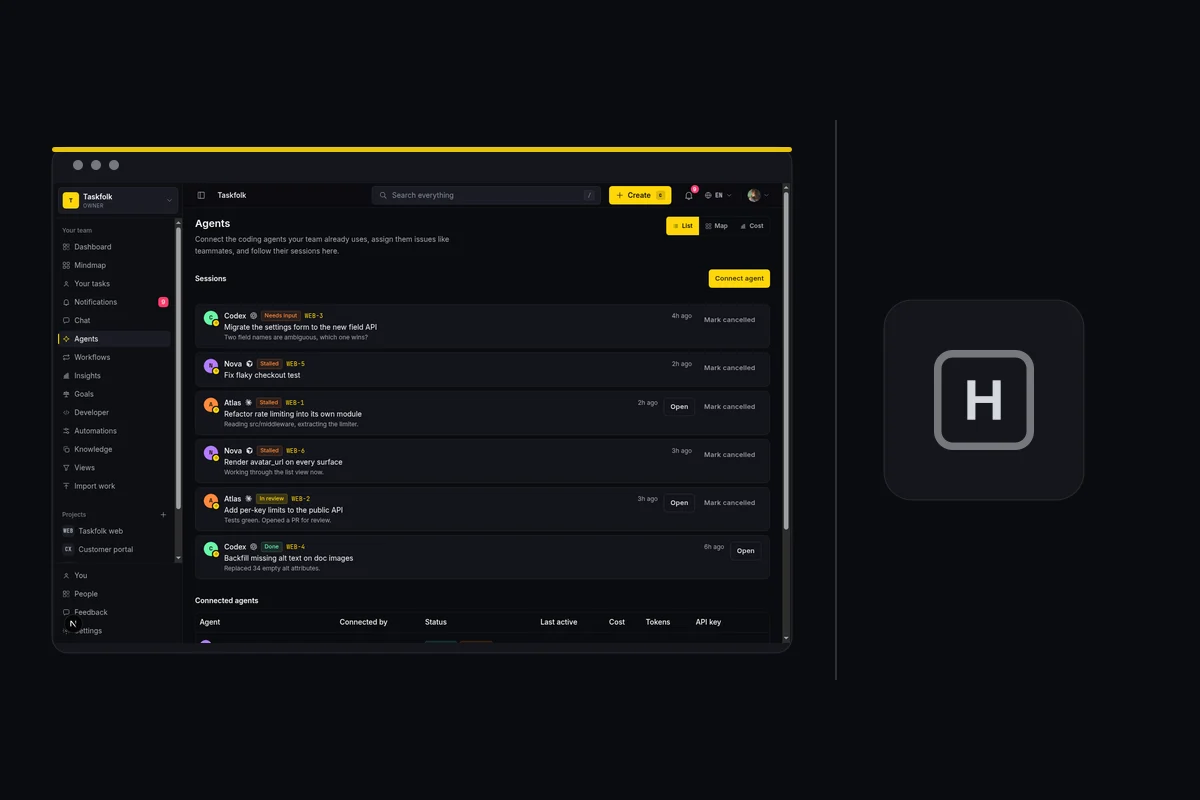
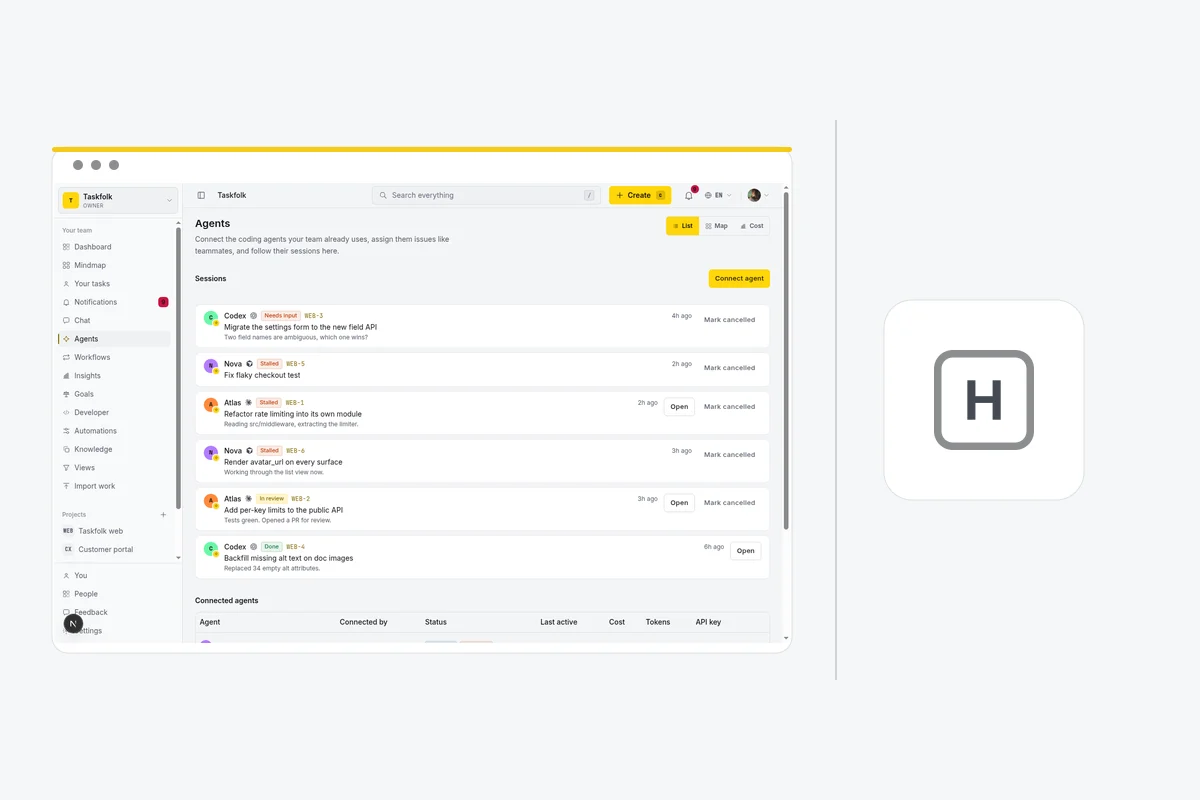
Height was a fast, keyboard-driven tracker that bet early on AI running project admin, and it shut down on September 24, 2025. Taskfolk carries the same bet forward: the agent is a member of the team, with a name, a session you can watch, and limits on what it may change.
Last updated: 15 Jul 2026
The quick answer
Height shut down on September 24, 2025, so this is less a comparison than a relocation guide. Height bet on AI running project admin in the background; Taskfolk carries the same bet forward with the agent as a named member you assign issues to, a live session on the ticket, and every change attributed. Export your data to CSV if you have not already, import it into Taskfolk, and your team is back on a board in an afternoon. Free plan covers unlimited members with no issue cap; Pro is $3 per builder.
The short version.
Pick Taskfolk if
- You want AI coding agents assigned to issues as named members, with sessions you can follow and per-agent limits on which fields they may write.
- Most of your company reads the work and never edits it. Viewers are free on Taskfolk with no cap; on Height everyone is a seat.
- You need sprints, velocity, burndown, a timeline with dependencies, docs, forms, and chat in the same product.
Stick with Height if
- You like its autonomous approach: letting AI chase updates and tidy the backlog without you assigning anything.
- Your team values the keyboard-first speed and the smaller, quieter surface.
- You are already on it and the seat count is not large enough for price to matter.
Feature by feature.
| Feature | Taskfolk |  Height Height |
|---|---|---|
| Price, standard tier | $3 per builder / month. Viewers free, no cap | $6.99 per member / month billed annually ($8.50 monthly) |
| Free plan | Unlimited members, 5 projects, no issue cap | Discontinued. Height shut down Sept 24, 2025 |
| Free read access | Viewers free, unlimited, on every plan | No, members are paid seats |
| Boards, backlog, sprints | Yes, native | Lists, boards, and calendar; lighter sprint model |
| Velocity and burndown | Yes, out of the box | No native velocity or burndown reports |
| Custom statuses and workflow rules | Yes, per project, with transition rules and WIP limits | Custom statuses and attributes |
| AI approach | Agents you assign, with sessions and attribution | Autonomous background AI handling project admin |
| Named AI agents as members | Yes, with their own profile, API key, and attribution, never billed as seats | No, AI is a product capability rather than a member |
| Live agent sessions on the ticket | Yes, see which agent is running, blocked, or ready for review | No |
| Per-agent write limits | Yes, restrict which fields each agent may change | No |
| Docs and wiki | Built in | Notes and docs, lighter |
| Timeline / Gantt | Built in, with dependencies | No dependency timeline |
| MCP server | Yes, first-party, covers the full API | No first-party MCP server |
| REST API | Yes, over 180 operations, full product coverage | Yes |
| Trial | 14 days of Pro on your first workspace, no card | Free plan, then paid per seat |
Rival prices and limits are public list prices as of August 2026. Check height.app/pricing for current numbers.
What a real team pays.
Height is inexpensive per seat, and against Taskfolk's $3 the per-builder gap is small in absolute terms. The difference is the same one that runs through every comparison here: Height charges for everyone in the workspace, and most workspaces are mostly readers.
Team of 6 builders and 12 viewers, per month
- Height Team: 18 members x $6.99 = about $126
- Taskfolk Pro: 6 builders at $3 = $18, viewers free
For six engineers with no audience, Height is about $42 against Taskfolk's $18, which is close enough that features should decide it rather than price. Add the people who only watch and the gap opens sevenfold.
Run it on your own team
Count the people who create and move work, then the people who mostly read. That split, not the sticker price, is what decides the bill.
- TaskfolkProviewers free5 x $3$15 / month
- HeightTeamviewers are paid seats20 x $6.99$140 / month
Standard team tier, annual billing, public list prices as of August 2026. Monday has a 3-seat minimum and sells seats in buckets; its real bill is at least the figure shown.
Cheapest way to settle this is to try it
14 days of Pro on your first workspace, no card. Import a real project, put your actual team in, and look at the board on a Monday.
Where Height is genuinely strong.
The autonomous bet
Letting AI chase status updates and tidy the backlog without being asked is a real idea, and Height committed to it earlier than most. If you want the tool to do the admin rather than delegate it, that is the pitch.
Speed and a small surface
Keyboard-driven, quick, and free of the configuration sprawl that makes bigger tools tiring. Small teams feel that every day.
A low floor
A usable free plan and a cheap paid tier make it easy to start, with no seat minimums or bands to reason about.
Where Taskfolk is different.
Agents with names and limits
An agent joins as a member with its own profile, API key, and attribution, and you can restrict which fields it may write. Background automation is invisible; a named teammate with an audit trail is reviewable.
The reporting a delivery team needs
Velocity, burndown, cumulative flow, workload, and a timeline with dependencies ship in the product rather than being left to the reader.
Only builders are billed
Viewers are free with no cap on every plan, so the whole company can follow the work without changing the bill.
Switching from Height.
The honest objection to any comparison page is the move itself. Here is what it takes, without the sales gloss.
Connect Height
There is no Height connector. Export your tasks to CSV from Height and upload it. Taskfolk auto-maps common headers like Name, Status, Assignee, and Due, and you can remap any column before the run.
Map the columns
You get a preview before anything is written. Match their statuses, types, and priorities to yours, and merge the columns that were always the same thing.
Run the import
Free workspaces import 1,000 rows per run, Pro 10,000, Business 50,000. Anything large runs in the background and emails you when it finishes.
Invite the team
Add the people who change work as members and everyone else as viewers. Viewers are free with no cap, so there is no reason to leave stakeholders out.
What comes across
Titles, types, statuses, priorities, assignees matched by email, labels, descriptions, comments, attachment links, due dates, and estimates.
What does not
Activity history, tool-specific custom fields, and automation rules. Rules are worth rebuilding by hand anyway; most teams find half of them were dead.
Height lists map onto Taskfolk projects and its statuses onto board columns, so the shape survives the move. Attributes without a Taskfolk equivalent become custom fields.
If it does not work out
Your data stays yours
Every issue, comment, and attachment is readable through a REST API with over 180 operations. Nothing is trapped in a format only we can open.
No card to start
The trial needs an email address. There is no card on file, so there is nothing to cancel if you walk away.
Free is a real plan
When the trial ends the workspace drops to Free and keeps working. It does not lock, and it does not hold your issues hostage.
Common questions.
How is Taskfolk's agent model different from Height's AI?
Height's bet is autonomy: AI works in the background, chasing updates and tidying the backlog without being assigned anything. Taskfolk's bet is accountability: the agent is a named member with a profile, an API key, and issues assigned to it, a session you can watch on the ticket, and limits on which fields it may write.
Is Height cheaper than Taskfolk?
No. Height Team is $6.99 per member billed annually against $3 per builder on Taskfolk, and Height bills everyone in the workspace while Taskfolk viewers are free. Six builders and twelve viewers is about $126 a month on Height and $18 on Taskfolk.
What does Taskfolk not have that Height has?
The autonomous posture. Height will do project admin without being asked, which is a genuinely different philosophy from delegating work to a named agent and reviewing it. Its smaller, quieter surface is also a real advantage for a small team.
Is Height shut down, and what should Height users do?
Yes. Height shut down on September 24, 2025, after announcing the closure six months earlier. If you exported your workspace to CSV, Taskfolk imports it: lists map to projects, statuses map to board columns, and unmapped attributes become custom fields. The Free plan has unlimited members and no issue cap, so a former Height team can land without buying seats first.
Try the whole thing free.
Every new team gets 14 days of Pro on their first workspace, no card. Connect an agent, assign it a real issue, and watch the session on the ticket.