What AI in project management software really costs
What AI project management software really costs in 2026: the seat price, the credit line underneath it, and how to turn an allowance into a number of runs.

A pricing page gives you one number per seat. The invoice has a second line under it, labelled credits or actions, that nobody on the team remembers agreeing to.
Here is the version I can document, read off Atlassian's own pages on 26 July 2026. Ten developers on Jira Standard is $9.05 per user per month. Rovo Dev Standard adds $20 per developer on top and includes 2,000 Rovo Dev credits.
Past those, extra usage bills at $0.01 per credit, and the FAQ on that same page sets "a default monthly limit of 2,000 Rovo Dev credits per user" unless an admin goes and changes it. So the $9.05 seat is really a $29.05 seat, carrying a further $20 per developer of overage that is already switched on. Ten developers, $200 a month, and nobody made a second decision.
That is not a trick, and Atlassian publishes more than most vendors below. It just was not in the number you compared. One boundary before the table: this post is what the vendor charges you. What your own agent burns on its own provider account is a separate post.
Five shapes, and only one of them is a price
Vendors charge for AI in five ways. Only one of them lets you build a budget before you sign.
Bundled into the seat. Trello is $5 a user on Standard, $10 on Premium, with AI on cards and no meter at either tier. You cannot overspend. You also cannot find out what you are entitled to.
A per seat credit allowance. A Jira Standard seat carries 25 Rovo credits a month, ClickUp bundles 1,500 Super Credits with its Brain AI add-on, and monday attaches 1,000 to Basic. The credit is the vendor's own unit, and the vendor sets the exchange rate.
A separate add-on subscription. ClickUp Brain AI is $9 per user on top of a $7 or $12 workspace seat. Rovo Dev Standard is $20 per developer on top of Jira. The seat price you compared was never the whole product.
Consumption billing, quoted in dollars. Linear prices the work instead of the allowance: $0.50 to $1 for a styling tweak, $3 to $5 for a small bug fix, $0.07 to $0.20 for an agent loop. It is the only vendor here you can multiply by a frequency and get an answer.
An undisclosed quota. Wrike Business gets "a starter pack of AI Elite actions", Pinnacle "3 times more", Apex "10 times more", and the size of the starter pack appears nowhere. Asana ships 50,000 AI Studio credits per billing account on Starter and publishes no price for AI Studio Plus, Pro, or AI Teammates. This is the most expensive shape to buy, because you cannot compare it against anything.
flowchart TD
  A["Vendor charges for AI"] --> B{"Separate line on the bill?"}
  B -->|"No"| C["Bundled in the seat"]
  B -->|"Yes"| D{"Metered or subscribed?"}
  D -->|"Subscribed"| E["Add on subscription"]
  D -->|"Metered"| F{"Unit price published?"}
  F -->|"In dollars"| G["Consumption billing"]
  F -->|"In credits"| H["Credit allowance"]
  F -->|"Not published"| I["Undisclosed quota"]
What each vendor charges, read on 26 July 2026
We make Taskfolk, one of the rows below, so read that row as an interested party. Every other row comes from the vendor's own pricing or help page. monday and Notion served me euros, so those two seat figures are the euros I saw. ClickUp and monday block automated readers, so the per action rates there are third party and marked.
| Vendor and plan | Seat / mo | Allowance and cost per action | What that buys |
|---|---|---|---|
| Jira Standard | $7.91 at 300 seats, $9.05 at 10 | 25 Rovo credits per user, 10 per agent request | 2.5 requests per user |
| Jira plus Rovo Dev Standard | $7.91 plus $20 per developer | 2,000 Rovo Dev credits, then $0.01 each | 20 to 75 code reviews, per Atlassian |
| ClickUp Business plus Brain AI | $12 plus $9 = $21 | 1,500 Super Credits at $0.001, 100 to 300 per run (third party) | 5 to 15 runs per user |
| Notion Business | 19.50 euro as served | no grant, $10 per 1,000 credits | 90 to 333 question answering runs per $10 |
| Asana Starter | $10.99 | 50,000 per billing account, unit cost not published | not computable |
| monday Basic | 9 euro as served | 1,000 per account, 10 to 250+ per agent task (third party) | 4 to 100 tasks per account |
| Linear Business | $16 | no grant, $0.07 to $0.20 per agent loop, $3 to $5 per small bug fix | as many as you fund |
| Trello Premium | $10 | AI on cards, no quantity published | not published |
| Wrike Business | $25 | "a starter pack of AI Elite actions", size not published | not published |
| Taskfolk Pro | $3 | 5,000 per workspace at a cent each, about 9 per chat turn | about 555 turns per workspace |
Three of those ten rows publish no quantity at all, and two more are only computable through third party reporting because the vendor's own help centre will not let a reader in. For the seat side alone, what you actually pay per seat does that arithmetic.
The division nobody publishes
Take ClickUp, because for once every number sits on one page. Business is $12 per user per month billed annually, Brain AI is another $9, and the working number is $21.
Now price the credits inside that $9. ClickUp sells extra Super Credits on the same page at $10 per 10,000, a tenth of a cent each. What 1,500 of them buys is third party, since the help centre refuses automated readers: a Super Agent run is reported at 100 to 300 credits.
Brain AI subscription     $9.00 per user per month
Bundled 1,500 credits     $1.50 at ClickUp's own $0.001 rate

1,500 / 300 per run  =  5 agent runs per user per month
1,500 / 100 per run  = 15 agent runs per user per month
So the credits inside that $9 are worth $1.50 at ClickUp's own resale rate, and they buy five to fifteen agent runs per person per month on the $21 configuration. Under four a week at the generous end. Jira's version of the same division is shorter and worse, and it is worked through in the Jira post.
What happens when the meter hits zero
stateDiagram-v2
    [*] --> Allowance
    Allowance --> Spending : agents run
    Spending --> Exhausted : allowance hits zero
    Exhausted --> Paused : Notion
    Exhausted --> Refused : Linear
    Exhausted --> Overage : Rovo Dev and ClickUp
    Exhausted --> Unknown : Wrike and Asana
    Paused --> Allowance : cycle resets
    Refused --> Allowance : you top up
    Overage --> Allowance : you are invoiced
Notion pauses. Custom Agents "will pause automatically until credits reset or an admin adds more credits", and admins get alerts at 80% and 100% first. Notion is the only vendor here that publishes runs per dollar: $10 buys 1,000 credits, which it puts at roughly 90 to 333 runs of a question answering agent, so $0.03 to $0.11 each. A daily brief agent is dearer: 33 to 100 runs for the same $10.
Linear refuses. Once the balance is gone, "features that require a balance will not be able to begin new work". Top-ups start at $10 and a purchased balance does carry across billing cycles, but it expires 12 months after purchase and cannot be refunded or moved once it has.
Atlassian, for now, does nothing. Rovo credits pool at the organisation level, reset monthly, cannot be banked, and Atlassian says it is "not currently billing for extra usage above your Rovo credit allowance", with at least 90 days notice promised before that changes. Rovo Dev credits are the separate currency it does bill for today.
ClickUp will sell you more on the same page as the plan, and Wrike and Asana publish no quantity at all. A vendor that halts your agents when the money runs out is doing you a favour. One billing quietly against an overage limit you never set is not.
Our own numbers, on the same axes
Ours is not a neutral row, so here is the working.
Seats are $3 per editor per month on Pro and $6 on Business, or $30 and $60 a year. Viewers never count as a seat, and neither do connected agents.
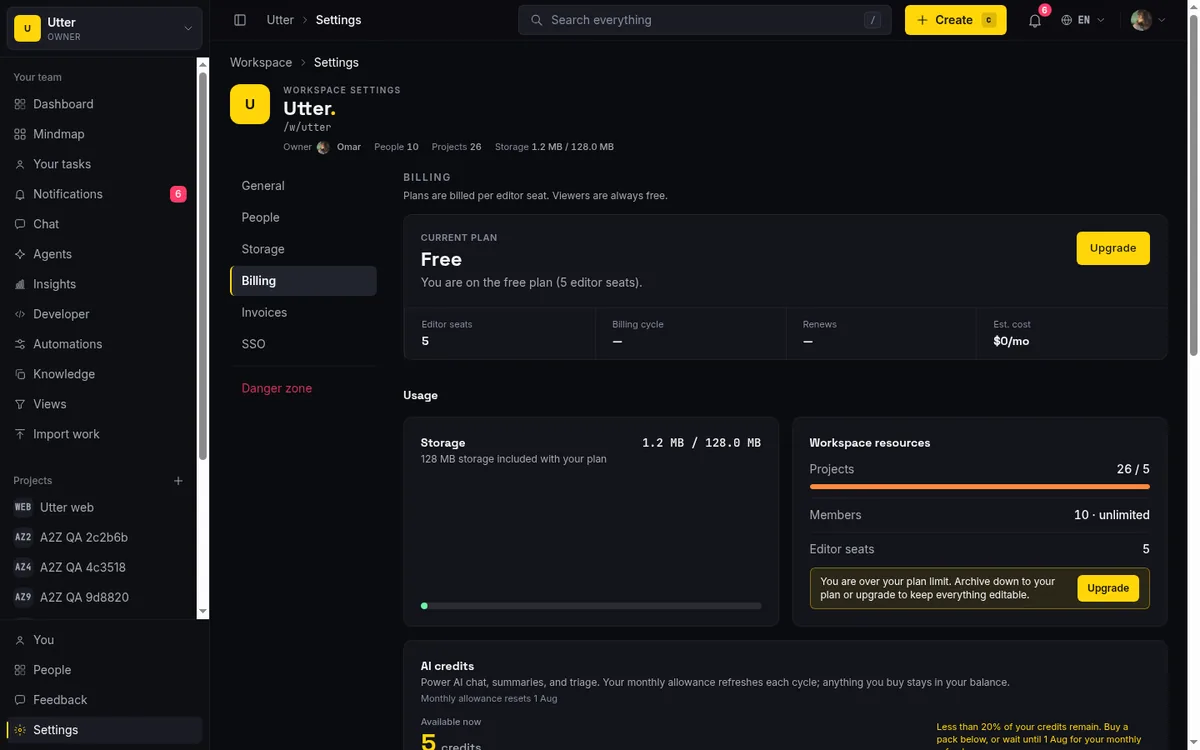
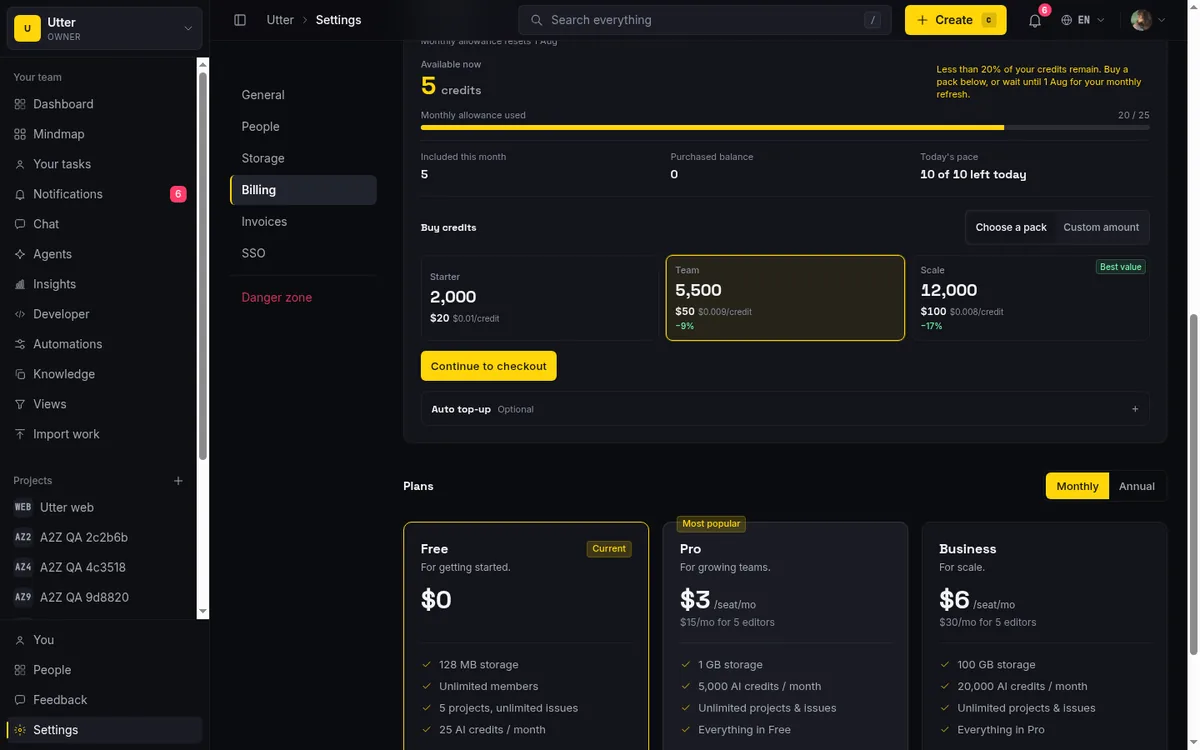
The AI allowance is 25 credits a month on Free, 5,000 on Pro and 20,000 on Business, and none of it rolls over. One credit is a cent of list AI value, billed per model against the tokens a call used and floored at one credit. On the default chat model that is 1,000 credits per million input tokens and 5,000 per million output.
Take a chat turn with 6,000 tokens of context and a 500 token answer. Those counts are an assumption on our side, not a published rate:
input   6,000 / 1,000,000 x 1,000 = 6.0 credits
output    500 / 1,000,000 x 5,000 = 2.5 credits
total                         8.5 -> 9 credits, $0.09
Pro's 5,000 credits is around 555 of those turns a month for the whole workspace, not per seat, so roughly a hundred each across five people. Free's 25 credits is under three turns. That is a taste, not a trial.
A second ceiling catches people out: a workspace spends at most 20 percent of its monthly allowance in one day, with a floor of ten credits.
export function dailyCreditLimit(grant: number, topup: number): number {
  return Math.max(10, Math.ceil((grant + Math.max(0, topup)) * 0.2));
}
That is 10 a day on Free, 1,000 on Pro and 4,000 on Business. On Free the floor binds rather than the percentage, so one enthusiastic Tuesday eats most of the month. Credit packs list at 2,000 for $20, 5,500 for $50 and 12,000 for $100, all of it on the billing page.
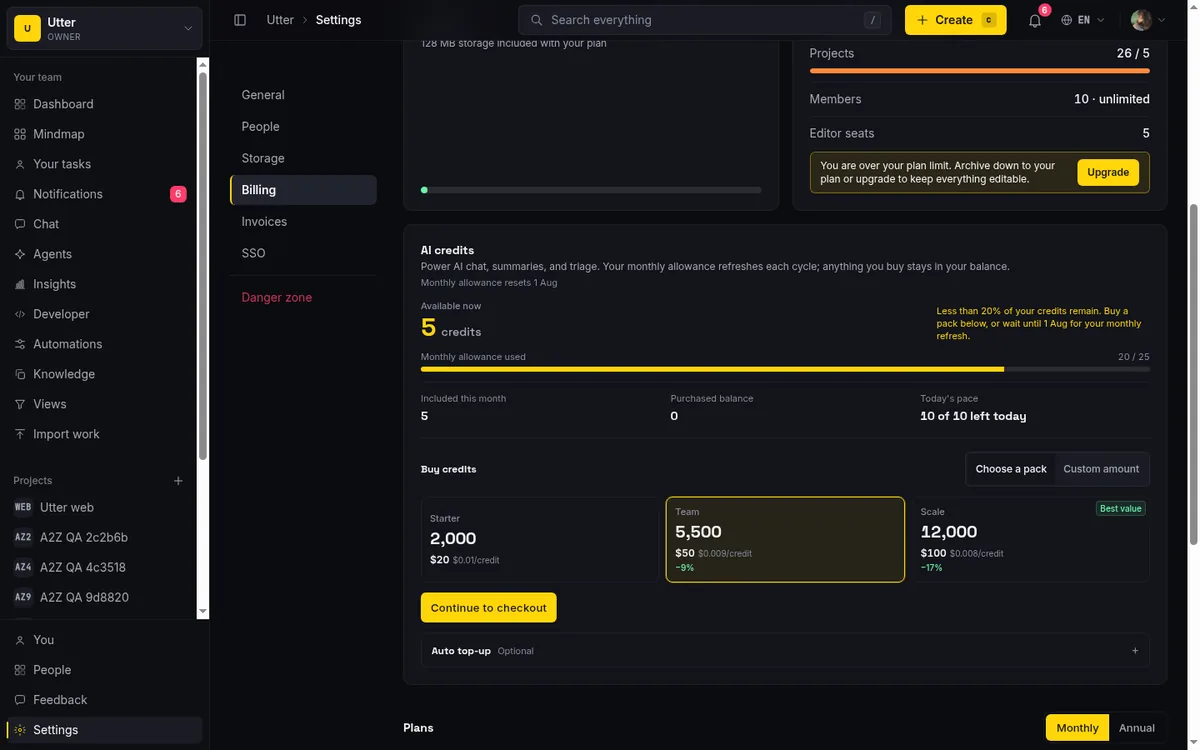
Plan, storage and credits read back over the API, today's ceiling included:
curl https://taskfolk.ai/api/v1/workspaces/acme/usage \
  -H "Authorization: Bearer tfk_live_..."
The agent that runs on your account, not ours
Everything above meters AI the vendor runs for you. A connected coding agent lands somewhere else on the bill.
Connect Claude Code, Cursor, Codex or another MCP capable agent and it becomes a real workspace member with its own identity and API key. Seat counting filters agents out, so fifteen agents on a five person team is still five seats. The agent runs on your machine or your CI against your own provider account, so its work consumes no Taskfolk credits. There is nothing on our side to meter.
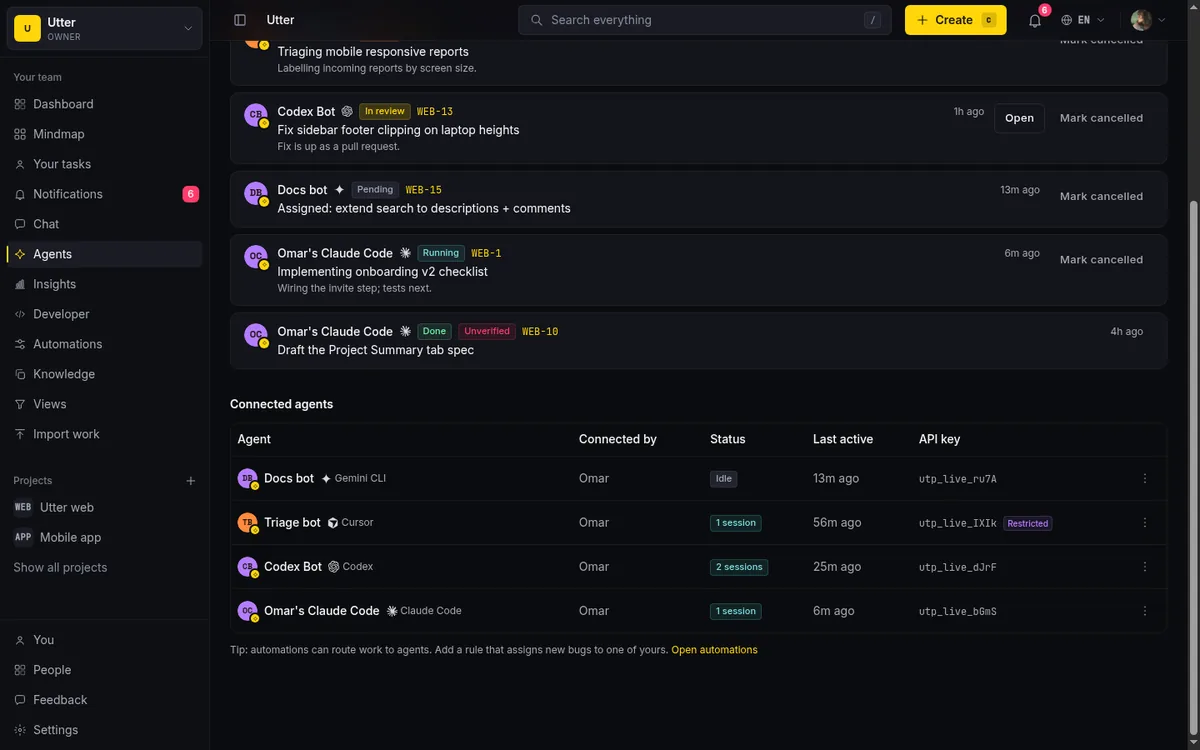
The same fact cuts the other way. We cannot see your provider spend, so we cannot cap or block it. A session carries what the agent reports back: cost, tokens, model, and where cost is missing we estimate it from the tokens. Those figures can alert you. They cannot stop the spend, and any tool claiming otherwise on your own API key is describing something it does not control.
We are not the only vendor that stopped charging a seat for a bot: monday's headline now reads "Plans for every team, people and agents included". The difference is what comes after. monday includes the agent and then meters its work in credits, while on our side that work never touches our meter because it never touches our models. The seat half of the argument is in do AI agents count as seats.
Budgeting without opening six pricing pages
Pick one unit of value, and do not let it be a credit. A triaged ticket, or a code review a human did not have to do. Then divide twice: price per unit times units per attempt gives cost per attempt, and that over your success rate gives cost per result. Failed attempts still bill.
Then ask any vendor four questions, in this order. What does one action of the kind I care about cost, in your unit? How many units does my plan include, and are they per seat or per account? Do they roll over? When they hit zero, does the product pause, refuse, or bill me?
Per seat versus per account moves more money than the seat price does. Asana's 50,000 credits are per billing account, and so are monday's 1,000, so the allowance thins with every person you add. If a vendor cannot answer the first question, the other three are academic. That was three of the ten rows above.
What this table does not tell you
Prices move, and the AI line moves faster than the seat line. Atlassian's "not currently billing" has a 90 day fuse on it, in Atlassian's own words, which makes the Jira rows the likeliest to be wrong by the time you read this. Re-read the vendor's page before you sign on the strength of a table, this one included.
Credits do not roll over, ours included, so an underused month is money handed back.
And our in-app assistant runs a curated set of eleven tools, not the whole API. The full catalogue of over 180 operations is open to agents over REST and MCP, and the chat box deliberately is not, so compare tool lists rather than credit grants if the assistant is what you are buying.
If you are choosing rather than budgeting, what to look for in an AI issue tracker and free tiers, honestly beat a price table. Our pricing page has the seat prices and credit grants if you want to run this arithmetic against us.
Frequently asked questions
What is an AI credit and what does one actually buy?
A credit is each vendor's private billing unit, and the vendor sets the exchange rate. Jira charges 10 Rovo credits per agent request, Notion sells 1,000 credits for $10 and puts that at roughly 90 to 333 runs of a question answering agent, and a Taskfolk credit is one cent of list AI value billed against the tokens a call actually used. Always ask what one action of the kind you care about costs in the vendor's own unit.
Do unused AI credits roll over to the next month?
Usually not. Atlassian states that unused Rovo credits cannot be banked for future periods, and Taskfolk resets the monthly allowance too. Linear is the exception: a purchased balance carries across billing cycles, but it expires 12 months after purchase and cannot be refunded once it does.
Can I hit a daily limit while I still have monthly credits left?
Yes, and it is the most common surprise. Taskfolk caps daily spend at 20 percent of the monthly allowance with a floor of ten credits, so Free is 10 a day even though the month grants 25. Most vendors also run per minute and per day rate limits they do not publish anywhere.
Does connecting my own coding agent use AI credits?
Not on our side. A connected agent runs on your machine or your CI against your own provider account, so its work consumes no Taskfolk credits and no editor seat. The tradeoff is that we cannot see or cap that provider spend either, only record what the agent reports back.
What is the cheapest way to run AI for a five person team?
Work out how many AI actions you will really run per month, then divide each vendor's allowance by its cost per action. A cheap seat with a per account allowance often costs more per action than a pricier seat with a per seat allowance, which is why the seat price on its own tells you very little.
Related reading

Jira can assign tickets to AI agents now. What actually changed
Agents in Jira went GA in May 2026 and Atlassian shipped its own coding agent in July. What it does, what it costs, and three things it does not change.
26 July 2026 · 11 min read

What an AI agent actually costs per task
Work out AI agent cost per task: attribute agent-reported spend to an issue key, divide by completed work rather than attempts, and read the result honestly.
26 July 2026 · 11 min read

Project management for solo founders (you plus a few agents is the team)
Project management for solo founders means capturing everything and letting a few AI agents do real work, at $0, with agents as free members not paid seats.
16 July 2026 · 11 min read

Jira alternatives in 2026: what you actually pay per seat
Six Jira alternatives compared honestly: Linear, ClickUp, Asana, Monday, Trello, and Taskfolk, with real per-seat math and where each one actually fits.
11 July 2026 · 8 min read

Free project management software: what the free tiers actually give you
What the free tiers of Trello, Asana, ClickUp, Notion, and Jira actually give you (as of July 2026), which cap stops a small team first, and how Taskfolk Free compares.
16 July 2026 · 11 min read

The MCP audit: which project tools can AI agents actually use? (July 2026)
We audited the MCP servers of 13 project management tools: who has one, what agents can really do, the call caps, and the gaps nobody mentions.
15 July 2026 · 7 min read
Do AI agents count as seats? The real cost of running agents on your tracker
Two costs get blurred together: paying a seat per bot, and the tokens the model burns. Here is how to separate them and estimate what agents actually cost.
15 July 2026 · 6 min read

Asana alternatives that cost less and speak agent
Asana alternatives for growing teams: how Asana's tiered seats round your bill up, and how Taskfolk's $3 per-editor pricing with free viewers and agents changes the math. As of July 2026.
16 July 2026 · 12 min read
The best AI project management software in 2026, honestly ranked
Eight AI project management tools ranked with a stated lens: what the AI really does, what it costs on top of the seat price, and who each one fits.
15 July 2026 · 10 min read

The best AI task management tools in 2026, honestly compared
AI task management splits into two jobs: scheduling your own day and getting agents to do the work. We compare Motion, Todoist, Notion, ClickUp, Sunsama, and Taskfolk.
22 July 2026 · 9 min read
Add a comment
Start the conversation.